
Health and Social Care
Risk Assessment Training
A comprehensive three-hour course for healthcare and support workers in Scotland. Covering the legal duty to assess risk, the five-step risk assessment framework, risk ratings, best practice, and how to review and improve your own workplace documentation.
Duration
3 Hours
3 hour session covering risk assessments
Format
In person
Face-to-face classroom training
Location
Onsite
At our training facility in Dumfries
Certificate
Valid For 3 Years
CTC certified
Risk Assessment Training
Welcome to our comprehensive Risk Assessment Course designed specifically for healthcare and support workers in Scotland. In the dynamic and critical field of healthcare, understanding and effectively managing risks is paramount. This course has been crafted to equip you with the essential knowledge and skills to navigate the complexities of risk assessment, ensuring the safety and well-being of both patients and professionals.
How the course runs
- What is risk assessment and why is it compulsory
The session opens by establishing what risk assessment is, why it is a legal requirement under the Management of Health and Safety at Work Regulations 1999, and what happens when it is poorly done or neglected. Participants explore the duty of care owed to individuals, colleagues, the organisation and why risk assessment matters especially in healthcare settings. - The five steps, theory and work examples
Participants work through each of the five steps in detail, identifying hazards, deciding who might be harmed, evaluating existing controls and deciding on additional precautions, recording findings, and reviewing. Worked examples from care settings ground the framework in familiar, recognisable scenarios. - Risk ratings & understanding likelihood vs severity
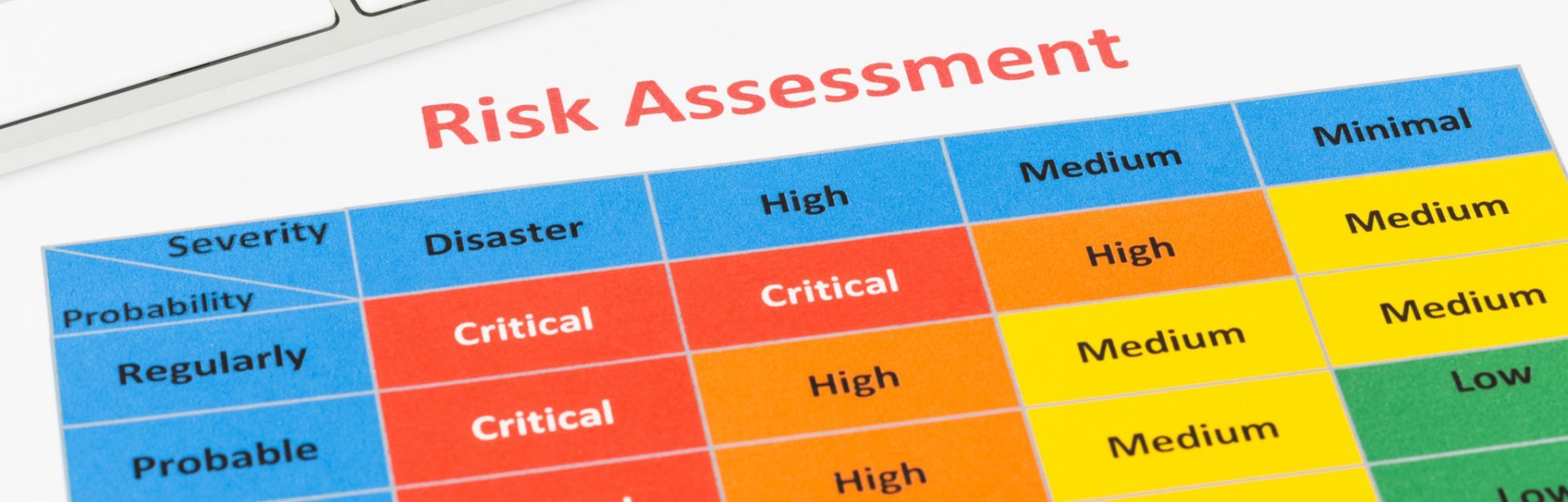
Participants learn how to use risk rating matrices, understanding the relationship between likelihood and severity, how to score risks consistently, and how risk ratings should influence the priority and nature of controls put in place. Group discussion explores common rating errors and how to avoid them. - Best practice &conditions requiring assessment
This section covers the conditions and situations that specifically require a risk assessment in healthcare and support settings, including manual handling, lone working, challenging behaviour, and environmental risks. Best practice guidance is explored, including how to write clear, actionable, and proportionate assessments. - Review your own risk assessment paperwork
A distinctive practical element, participants are encouraged to bring examples of risk assessment documents from their own workplace. With facilitator guidance, the group reviews and critiques real documentation, identifying gaps, inconsistencies, and opportunities to improve. This makes the learning immediately applicable back in the workplace. - Assessment, Q&A & certification
Continuous assessment runs throughout. The session closes with an open Q&A and knowledge check. Participants who complete all assessments successfully receive their CPD-certified certificate.
What you'll learn
✓ Understand what risk assessment is and it's role in the healthcare sector
✓ Understand the legal and compulsory nature of workplace risk assessments
✓ Apply the five step risk assessment framework confidently
✓ Use risk rating matrices to evaluate likelihood and severity accuracy
✓ Apply best practice to produce clear and proportionate risk assessments
✓ Review and improve your own workplace risk assessment documentation
✓ Identify the specific conditions and situations requiring a risk assessment
Before you arrive
Wear comfortable clothing and suitable footwear.
Certificate
CTC Certified for 3 years
Assessed through practical demonstrations and knowledge checks throughout the course. Successful completion earns a certificate valid for 3 years, and the training can be recorded as part of your SSSC Continuous Professional Learning (CPL). Renew through further training when your certificate expires.
Searching Availability...
No upcoming dates available?
Contact us and we’ll work with you to schedule a session that fits your organisation’s needs.
